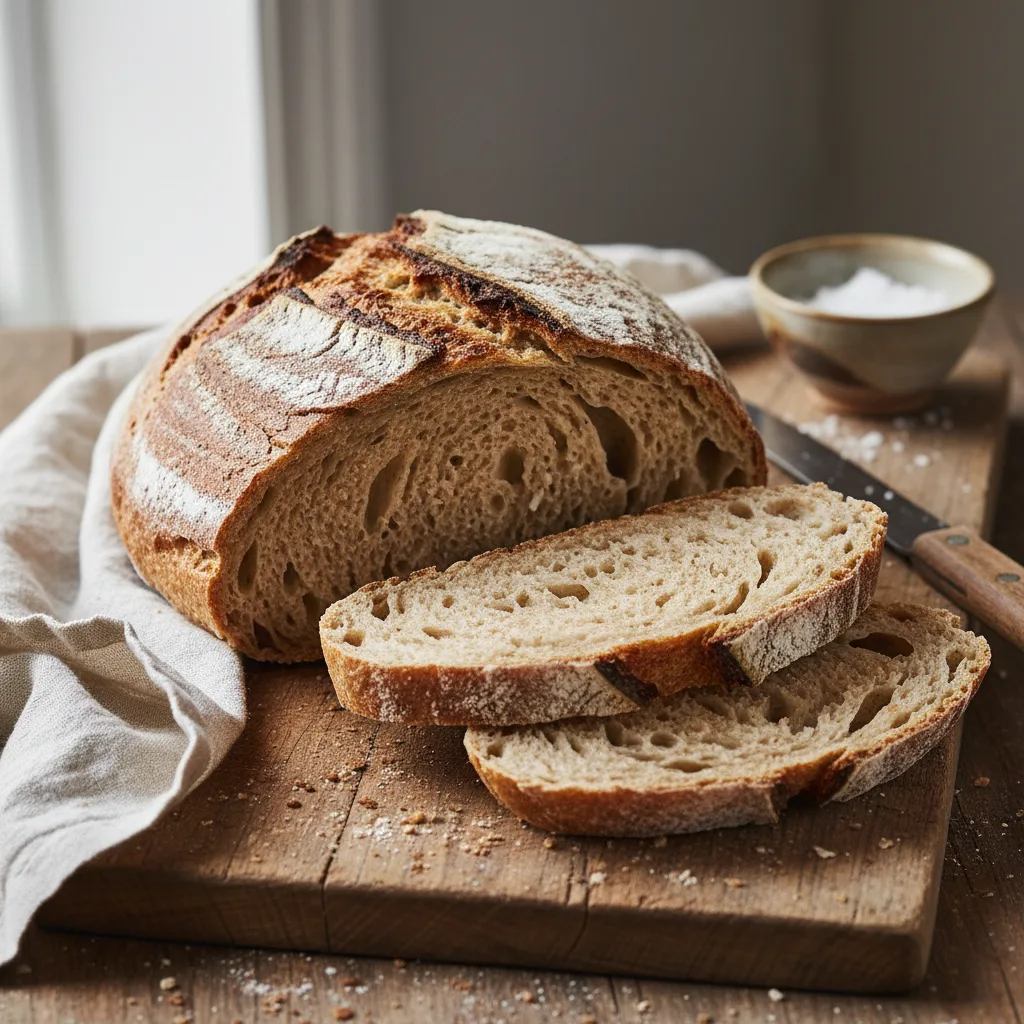
100% Whole Wheat Sourdough Bread
Vegan • Vegetarian • Dairy-FreeBaking • Meal Prep Friendly • 5 Ingredients or LessComfort Food
Medium
24h
162kcal
12people
MACROS
per serving※gProtein
◆gFat
▣gCarbs
◎gSugar
◇gFiber
Want to see the exact Macros for this meal? Download the Kitchen Buddy app and unlock full nutritional insights!
A robust, 100% whole wheat artisan sourdough bread utilizing vital wheat gluten to ensure a lofty, airy crumb and a deeply flavorful, crusty exterior.
Baking a 100% whole wheat sourdough loaf is a rewarding challenge that results in an incredibly flavorful and nutritious bread. Because the bran in whole wheat flour acts like tiny scissors, it can cut through the gluten network, often resulting in a dense, flat loaf. That is exactly where vital wheat gluten comes to the rescue! By adding just a small amount, we reinforce the dough's structure, allowing it to trap the gases produced by your active sourdough starter and giving the bread a gorgeous oven spring. Additionally, whole wheat is incredibly thirsty. You will notice the hydration (water content) is significantly higher than in a standard white flour recipe. Don't be afraid of the wet dough; that extra moisture is the secret to a tender, chewy crumb. Enjoy this deeply nutty, hearty, and wholesome loaf!
Ingredients
- 100 g Active Sourdough Starter
- 430 g Warm Water
- 500 g Whole Wheat Flour
- 20 g Vital Wheat Gluten (about 2 tbsp)
- 10 g Sea Salt
Instructions
- 1Step 1: Ensure your active sourdough starter is bubbly, doubled in size, and passes the float test before you begin.
- 2Step 2: In a large bowl, whisk together the active sourdough starter and 400g of the warm water until the starter is mostly dissolved.
- 3Step 3: Add the whole wheat flour and vital wheat gluten to the bowl. Mix by hand or with a sturdy spoon until a shaggy, rough dough forms and no dry spots remain. Cover the bowl and let it rest (autolyse) for 45 to 60 minutes.
- 4Step 4: After resting, sprinkle the sea salt over the dough. Add the remaining 30g of warm water to help dissolve the salt. Dimple the dough with your fingers and pinch it together until the salt and water are fully incorporated.
- 5Step 5: Over the next 2 hours, perform 4 sets of 'stretch and folds' spaced 30 minutes apart. Pull one side of the dough up and fold it over itself, rotating the bowl until all four sides have been folded. Cover the bowl between sets.
- 6Step 6: Let the dough sit at room temperature for the remaining bulk fermentation. It should grow by about 50%, look slightly puffy, and have a few bubbles on the surface. Whole wheat ferments a bit faster, so this usually takes 2 to 4 hours depending on your kitchen's temperature.
- 7Step 7: Turn the dough out onto a lightly floured surface. Shape it into a tight, round boule by gently folding the edges into the center and flipping it over so the smooth side is up. Drag it slightly towards you to build tension on the surface.
- 8Step 8: Place the shaped dough upside down (seam side up) into a generously floured proofing basket or a bowl lined with a floured towel. Cover it and place it in the fridge overnight (8-16 hours) for its cold proof.
- 9Step 9: The next day, place your empty Dutch oven inside the oven and preheat to 250°C (485°F) for at least 45 minutes.
- 10Step 10: Turn the dough out onto a piece of parchment paper. Use a sharp blade or razor to score a design or a single deep slash across the top.
- 11Step 11: Carefully transfer the parchment paper and dough into the hot Dutch oven. Cover with the lid and bake for 20 minutes to trap the steam and encourage oven spring.
- 12Step 12: Remove the lid, reduce the oven temperature to 220°C (430°F), and bake for another 20 to 25 minutes until the crust is a deep, rich brown.
- 13Step 13: Remove the bread from the oven and let it cool completely on a wire rack for at least 2 hours before slicing. Cutting into warm bread will make the crumb gummy!
Chef's Tips
- •Always weigh your ingredients using a digital scale for bread baking; volume measurements (like cups) can be highly inaccurate.
- •Whole wheat flour absorbs liquid differently depending on the brand and how freshly milled it is. If the dough feels completely unmanageable, you can hold back 10-20g of water next time.
- •Scoring the dough dictates where the bread will expand in the oven so it doesn't burst randomly on the sides.
More recipes you might like

Medium55minuti210kcal
Hasselback Potatoes
Medium25minut245kcal
Homemade Air Fryer Bread

Easy25min180kcal
Sweet & Salty Roasted Coconut Chips
Medium15min235kcal
Air Fryer Mini Ciabattas
Medium20min445kcal
Original Italian Pizza Dough

Medium1godzina 30 minut780kcal
Homemade Pizza

Medium10min95kcal
Homemade Mint Lemonade

Medium60min280kcal
Classic Vanilla Crème Caramel

Easy25min350kcal
Sausage Rolls in Puff Pastry
K
Recipe By
Kitchen Buddy Chef